A recent fire safety case in Bournemouth is a clear reminder to landlords and holiday-let operators that fire safety cannot be left until an inspection takes place.
On 11 September 2026, Elizabeth Jean Watson was ordered to pay £23,290.13 at Weymouth Magistrates’ Court after failing to comply with requirements imposed by a fire safety inspector at a property being used as a holiday let.
What Happened
Dorset & Wiltshire Fire and Rescue Service (DWFRS) became aware that part of a property on Roslin Road, Bournemouth, was being let to holiday guests after a member of the public who had stayed there complained about a number of alleged fire safety failings.
Fire safety inspectors made repeated attempts to gain access to the premises to carry out an inspection. Access was refused each time.
The case went to trial and proceeded in the defendant’s absence. She was found guilty of failing, without reasonable excuse, to comply with requirements imposed by a fire safety inspector — an offence under Article 32(2)(e) of the Regulatory Reform (Fire Safety) Order 2005.
The total ordered by the court was made up of:
- £1,100 fine
- £440 victim surcharge
- £21,750.13 in prosecution costs
The fine itself was relatively small. The prosecution costs were almost twenty times larger — and they would have been avoided entirely by allowing the inspection to go ahead.
Holiday Lets Are Not Exempt
Many owners assume that a holiday let is treated like a private home. It is not. A property let to paying guests on a short-term basis falls under the Regulatory Reform (Fire Safety) Order 2005, and the owner or operator is the Responsible Person with legal duties to assess and manage fire risk.
Fire and rescue services have the power to enter and inspect these premises, and to require the Responsible Person’s cooperation. Refusing that cooperation is an offence in its own right — regardless of what the inspection would have found.
This is not an isolated case. In April 2025, a St Ives holiday-let business was ordered to pay more than £33,000 in fines and costs after an inspection found inadequate fire risk assessments, insufficient fire detection and deficient evacuation arrangements. The business had also spent around £25,000 putting the problems right.
What Does This Mean for Landlords?
The case highlights an important point: fire safety is an ongoing responsibility, not a one-off job.
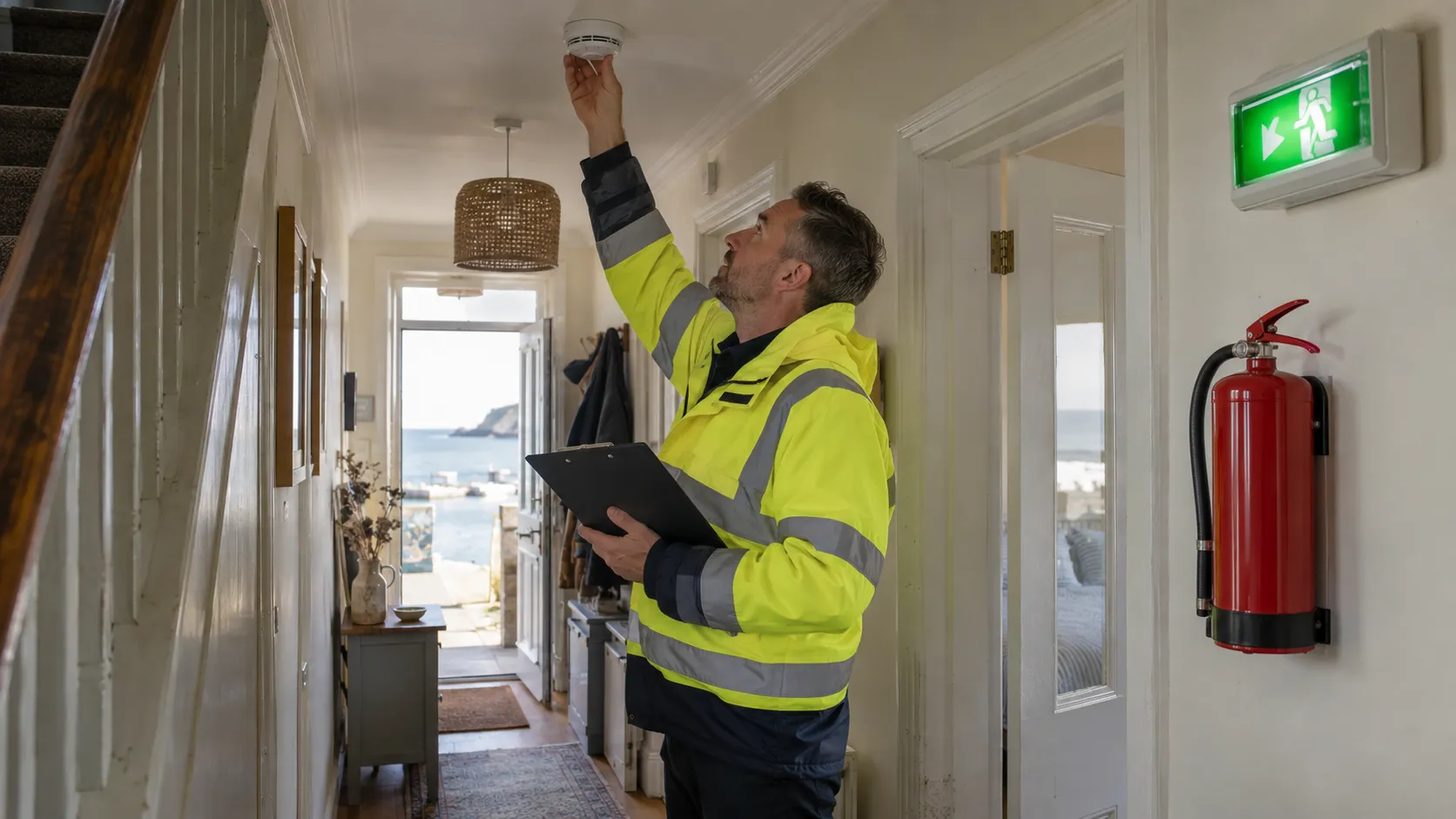
Landlords, holiday-let operators and property managers should make sure that appropriate fire safety arrangements are in place and that systems are regularly inspected, tested and maintained. Depending on the type and use of the property, this can include:
- Fire alarms and smoke detection — maintained in accordance with the appropriate requirements, including BS 5839.
- Fire extinguishers — inspected and maintained in accordance with BS 5306-3:2017.
- Emergency lighting — designed and maintained in accordance with the applicable requirements, including BS 5266-1:2025.
- Electrical installations — appropriate inspection and testing, including an EICR, in line with BS 7671 and relevant legislation.
- Portable electrical equipment — inspection and testing based on risk, following the IET Code of Practice for In-service Inspection and Testing of Electrical Equipment.
- Gas appliances and installations — where applicable, annual gas safety checks carried out by a Gas Safe registered engineer.
Underpinning all of this should be a suitable and sufficient fire risk assessment, reviewed regularly and whenever the use of the property changes — for example, when part of a home is converted into a holiday let.
Keep Your Records in Order
Keeping certificates and maintenance records up to date is an essential part of demonstrating that fire safety responsibilities are being properly managed. If an inspector visits, you should be able to produce:
- Your current fire risk assessment
- Fire alarm servicing and weekly test records
- Emergency lighting test records
- Fire extinguisher service certificates
- Your EICR and any PAT records
- Your gas safety certificate, where applicable
Good records do more than satisfy an inspector. They also support your position with insurers and give you evidence that you have taken reasonable steps if anything goes wrong.
Don’t Wait for the Fire Service to Find the Problem
The Bournemouth case shows that the consequences of failing to cooperate with fire safety enforcement can far exceed the cost of routine maintenance. It is also worth noting how it started — with a complaint from a guest. Your guests and tenants notice missing alarms, blocked exits and out-of-date extinguishers, and they can report them.
For property owners, the sensible approach is to identify problems before an inspection or incident occurs.
Read the official case: Dorset & Wiltshire Fire and Rescue Service — Woman fined for failing to comply with fire service safety inspection
How IDS Global Can Help
IDS Global provides fire safety maintenance for landlords, HMOs, holiday lets, commercial properties and property managers, including:
- Fire alarm installation and maintenance
- Fire extinguisher servicing
- Emergency lighting testing and maintenance
- Fire risk assessments
- Ongoing maintenance contracts
If you are responsible for a property and are unsure whether your fire safety systems, certificates and maintenance records are up to date, contact IDS Global for advice or a quotation.
Call us on 0203 761 1716, email info@idsglobal.co.uk, or request a callback today.